
Chicago #2: The Fire That Built Chicago
October 1871: the Great Chicago Fire destroyed 17,500 buildings and $200M in property. CBOT reopened the next day. The mechanism: Incumbency Erasure, eliminating every firm's accumulated advantages simultaneously, creating conditions for Jenney's first skyscraper and Thoma Bravo's $184B PE empire.

How the 1871 Great Chicago Fire Invented the Skyscraper and Proved That Chicago's Real Infrastructure Couldn't Burn
Also available on YouTube, Spotify & Apple Podcasts.
The stretch of South Water Street where Joseph Turner Ryerson's iron warehouse burned to the ground on October 9, 1871 is now Wacker Drive. Today, 110 North Wacker houses Thoma Bravo, a $184 billion private equity firm. Between Ryerson and Thoma Bravo, every generation of Chicago capital has followed a similar logic: disruption clears the incumbents, but the infrastructure and the operators survive. Whoever rebuilds fastest wins the next era. The fire is where this pattern started.
The Great Chicago Fire consumed 2,124 acres, killed approximately 300 people, left 100,000 homeless, and destroyed the entire business district of America's fastest-growing city. $200 million in property evaporated (~$4.8 billion today). By any rational measure, it should have ended Chicago as a commercial force. New York business interests immediately began offering relocation incentives. St. Louis newspapers declared Chicago "finished." Eastern insurance executives arrived expecting to survey ruins.
Instead, they found merchants already reopening in temporary structures.
Sign up for Ventureology
This episode is free for all subscribers. Most future episodes and premium biographies will be Partner-tier access only.
Become a Founding PartnerThe first 100 paid subscribers get founding member pricing locked in for life.
Within 23 months, Chicago had completely rebuilt its business district. Within 13 years, it had invented the skyscraper. Within 22 years, the World's Columbian Exposition drew 21.5 million visitors to a city that had burned to rubble. How did a city absorb the equivalent of a $4.8 billion property loss, displace 100,000 residents, and rebuild faster than any comparable disaster in American history, not just to its prior state, but to something structurally superior?
The answer is embedded in five words spoken by Reverend Robert Collyer while standing in the ruins of his burned church: "We have not lost our geography."
The fire destroyed everything physical Chicago had built since 1830. It didn't touch what actually gave Chicago its advantage: geographic position, railroad convergence, institutional standards, and the trust networks the 82 merchants who founded the Chicago Board of Trade had spent 23 years building. Of the $90–100 million in insurance claims (~$2.4–2.7 billion today), policyholders recovered roughly 40 cents on the dollar; 58 of the 129 insurance companies operating in Chicago went bankrupt paying them. The physical loss was staggering. Collyer's five words were not consolation. They were the competitive analysis. The fire was the largest laboratory in American history for testing what competitive infrastructure is actually made of.
This is the story of what the fire proved.
ACT I:
THE STORY
The City Built of Tinder
State & Monroe Streets, Chicago. October 1871. Potter Palmer’s new hotel rose seven stories above Chicago’s most prestigious intersection, the grandest building in the city. Thirteen days old. Built entirely of wood.
Chicago in October 1871 was exactly what Frederick Law Olmsted had warned about. Olmsted, who had designed Central Park in New York and would later shape the grounds of the 1893 World’s Columbian Exposition, visited Chicago in 1871 and saw the contradiction immediately. The city had grown over 20x in 25 years, from 16,000 residents in 1848 (the year the Illinois & Michigan Canal opened and the CBOT was founded) to 334,000 by 1871. The speed of that growth was its own vulnerability. Lumber from Michigan and Wisconsin forests was abundant and cheap. A four-story building could rise in weeks. Building codes were minimal. Insurance was lax. In "Chicago in Distress," his November 1871 dispatch for The Nation, Olmsted noted that Chicago had a weakness for "big things," and that its walls were thin and overweighted with "gross and coarse misornamentation."
Chicago’s most prominent citizens had built their fortunes on this unsustainable model. Palmer had staked his reputation on the Palmer House, the hotel at State and Monroe that embodied everything Olmsted criticized: speed over permanence, spectacle over structure. William Butler Ogden, Chicago’s first mayor, Union Pacific’s first president, and one of CBOT’s key early supporters, owned extensive real estate across the Loop. CBOT occupied a grand building at the corner of Washington and LaSalle designed to project Chicago’s importance in global grain markets.
The warning signs were everywhere and ignored. In 1857, Chicago suffered a major fire that destroyed several blocks. In 1866, another. In October 1870, exactly one year before the Great Fire, a significant blaze destroyed multiple blocks on the South Side. The Chicago Daily Tribune warned repeatedly about construction quality and fire preparedness. City leaders prioritized growth.
The summer of 1871 had seen minimal rainfall. By early October, the wooden buildings, wooden sidewalks, and wooden bridges of Chicago's central business district were perfect kindling. The Chicago River, which should have served as a natural firebreak, was lined on both banks with lumberyards and coal storage. It would not function as a firebreak. It would function as an accelerant.

The Great Chicago Fire, 1871. Chromolithograph by Gibson & Co. — Library of Congress
Sunday Night, October 8, 1871
Catherine O'Leary went to bed around 9 PM. Her barn at 137 DeKoven Street on the city's Southwest Side caught fire shortly after. By 9:30 PM, neighbors were shouting. By 10 PM, the flames had spread to surrounding structures. The Chicago Fire Department responded, but they were exhausted from a four-square-block fire the previous Saturday. Equipment was in poor condition. Water pressure was low.
How the fire started has never been conclusively proven. The cow-and-lantern story is a fabrication: reporter Michael Ahern of the Chicago Republican invented it to blame the Irish immigrant family, then admitted the hoax on the fire's 50th anniversary in 1921. The Chicago City Council formally exonerated Mrs. O'Leary and her cow in 1997, 126 years after the fire. What is known is what happened next.
Around midnight, burning embers carried by 30-mile-per-hour southwest winds crossed the Chicago River's South Branch, landing in the lumberyards and coal storage facilities lining the banks. The wind pushed the fire northeast toward the heart of Chicago's business district. By 2 AM Monday, October 9, the trajectory was clear. By 3 AM, the fire had reached the South Water Street area where CBOT's building stood.
General Philip Sheridan arrived at dawn Monday. The Civil War hero who had turned the tide at Winchester and saved Grant's flank at Five Forks now commanded a different kind of operation. Sheridan ordered explosives to create firebreaks, blowing up buildings ahead of the flames to remove fuel. The wind was too strong. The fire jumped every gap. His October 9 telegram to Secretary of War Belknap, preserved in full at greatchicagofire.org, opened simply: "The city of Chicago is almost utterly destroyed by fire."
By Monday afternoon, virtually the entire business district had burned. The Water Tower, one of the few structures to survive with its limestone walls deflecting the heat, stood as a sentinel amid ruin. Potter Palmer watched his 13-day-old hotel become ash. William Ogden watched his fortune vanish. Gurdon Hubbard, 70 years old and one of Chicago’s wealthiest merchants, watched his warehouses burn from across the street.
On Tuesday morning, October 10, the fire finally died. 2,124 acres destroyed. Seventeen thousand five hundred buildings gone. The entire business district: rubble.
The Documents That Didn't Burn
At 3 AM Monday, when most men were fleeing, Joseph Henry Hudlun ran toward CBOT. Born enslaved in Virginia around 1830, Hudlun had arrived in Chicago and become the first African American to build and own a home in the city. He worked at the Board of Trade, and he understood what the building contained. When the fire reached the exchange, he rushed inside and saved the institution’s critical documents: trading records, membership ledgers, and the grading standards that made Chicago grain fungible across every railroad and port in the country. The building could be replaced in months. The institutional memory those documents encoded would have taken decades to reconstruct.
J.T. Ryerson & Co. Still Lives
Joseph Turner Ryerson had spent 29 years building J.T. Ryerson & Son into Chicago’s premier iron and steel distribution business. His four-story warehouse at Michigan Avenue and South Water Street held $150,000 in inventory (~$3.6 million today). By Tuesday morning, it was ash.
Ryerson's response became the defining statement of Chicago's post-fire character. He issued a handbill Tuesday morning, while smoke still rose from ruins across the district:
"J.T. Ryerson & Co. still lives and will be ready for business as soon as they can find a place."
The Ryerson company history records his fuller statement from that period: "I shall do everything in my power to serve my customers as usual in my line of goods. I still live, and intend to do business, notwithstanding the awful calamity that has befallen our city."
That Tuesday afternoon, lumber arrived from Michigan. Before the last building stopped smoldering, construction materials were already flowing into Chicago by rail. Eastern businessmen who arrived to survey the damage, expecting to find a city broken, found merchants already rebuilding in temporary structures. New York commercial real estate interests had prepared relocation packages. Chicago merchants had prepared reconstruction contracts.
The speed was not chaos. The speed was the result of decision-making by people who had already assessed the situation clearly and reached the same conclusion independently: Chicago's structural advantages were intact. The geography Reverend Collyer named was intact. The canal was intact. The railroad convergence was intact. CBOT's grain grades were intact. The relationships, who owed whom, who trusted whom, who had honored their contracts through the war, were intact.
What was worth grieving was already grieved. What was worth rebuilding was already being rebuilt.
Sixty Days: The Reconstruction That Redefined American Speed
CBOT reopened in temporary quarters the day after the fire died. Grain trading resumed. Forward contracts cleared. The market didn't stop, because the market's infrastructure was never in the building.
Potter Palmer secured reconstruction financing within days and announced plans for a new Palmer House, across the street from the original site, bigger, better, with a specific commitment: "The World's First Fireproof Building." His architect, John M. Van Osdel, had buried his blueprints under sand and clay in the basement during the fire; they survived, convincing him that terra cotta would be an excellent fireproof material. Palmer obtained what was believed to be the largest individual signature loan of the era, $1.7 million (~$41 million today), to finance the rebuild.
The city immediately established new building codes. No more wood construction in the central business district. All new structures required brick, stone, or iron. The actual fire ordinance of February 12, 1872 prohibited balloon-frame construction across the Loop. Fire departments expanded. Insurance requirements tightened. The same pragmatic approach the CBOT founders had applied to grain trading in 1848: 1) identify the systemic vulnerability; 2) create enforceable standards; 3) iterate, now applied to urban construction.
W.F. Coolbaugh began clearing debris from his lot two days after the fire. The Central Union Block, five stories with fireproof construction and iron frames designed by architects F. & E. Baumann, opened for business 60 days after the fire. The Land Owner (February 1872) recorded: "He began to clear away the debris two days after the fire, and in sixty days the building was ready for occupancy."
The Sherman House hotel, completely destroyed, reopened bigger and better within months. By the end of 1872, within 14 months of the fire, Chicago had essentially rebuilt its entire business district. Within 23 months, the city was completely reconstructed, stronger, more systematically planned, and built with fire-resistant materials that made another catastrophe of this magnitude structurally impossible.
By 1884, Chicago had the world's first skyscraper. By 1893, it hosted the world's fair.
The fire didn't merely fail to end Chicago. The fire reinvigorated its growth.
Time to Rebuild After Total Destruction
Central business district recovery compared across history's worst urban fires and disasters.
From Ashes to the White City: Chicago's 25-Year Arc
Four milestones that trace Chicago's path from total destruction to hosting 21.5 million visitors at the 1893 World's Columbian Exposition.
ACT II:
THE ANALYSIS
The Incumbency Erasure Framework
The standard explanation for Chicago's post-fire recovery is cultural: Midwestern grit, pragmatic spirit, pioneer character. These descriptions are accurate but insufficient. Chicago didn't rebuild faster than any city in American history because its people were tougher. It rebuilt faster because its competitive infrastructure was categorically different from what burned.
Geography explains why Chicago survived. It doesn't explain why Chicago improved.
Those are different questions. Byrne Hobart has written how hub cities resist displacement because their competitive moat is network centrality, not physical assets; a spoke can relocate, but a hub's connections are too dense to disentangle. Hundreds of cities have survived disasters by virtue of geographic position: San Francisco in 1906, Galveston after 1900, New Orleans after Katrina. None of them came out the other side with more commercial capacity, more new businesses, and faster population growth than they had going in. Chicago did. The CBOT's 1872 annual report documents something that has no equivalent in American disaster history: "probably no year in our history has witnessed the appearance of so many new firms with substantial means and ability."
The mechanism that turned catastrophe into acceleration was specific and has been almost entirely overlooked in the standard Chicago Fire narrative: the fire produced what we call Incumbency Erasure, erasing every firm's accumulated advantages simultaneously.
In normal business conditions, established firms hold compounding advantages: existing customer relationships, supplier contracts, trained workforces, reputational capital, and physical assets paid off over decades. New entrants must overcome all of these simultaneously while incumbents operate with full resources. This is why new firms in stable markets face brutal odds. It is not talent or capital that protects incumbents. It is the accumulated friction of existing relationships.
Clayton Christensen would identify this pattern 126 years later. In The Innovator's Dilemma (1997), he demonstrated that incumbent firms fail not from incompetence but from rational optimization: they serve existing customers so well that they cannot pivot when the basis of competition shifts underneath them. What Christensen observed as a market phenomenon, Chicago experienced as a physical one. The fire did not merely damage incumbents. It eliminated the entire accumulated relationship infrastructure that protected them, at the same moment, for every firm in the city. The basis of competition shifted overnight from "who has the deepest existing relationships" to "who can rebuild fastest on the new terms." This is Christensen's framework made literal: the incumbents' greatest asset (decades of accumulated commercial relationships) became irrelevant in a single week.
The fire eliminated that friction simultaneously. Every Chicago merchant was rebuilding from scratch at the same moment. J.T. Ryerson was scrambling for a new location at exactly the same time his competitors were scrambling for new locations. The grain dealers who had dominated South Water Street for 20 years had no warehouse advantage over a sharp newcomer who arrived in November 1871. Old customers needed new suppliers. Old suppliers needed new customers. The entire commercial relationship network of Chicago's business district went up for renegotiation simultaneously. And the CBOT's grading standards, the ones Hudlun had saved, meant that every new firm entering those relationships could immediately signal credibility. A new iron merchant could prove himself against Ryerson's standard, not Ryerson's relationships.
Eastern capital understood this instantly. Investors arriving expecting a broken city found something rarer: an established market with destroyed incumbency and intact infrastructure. The underlying geography, the railroad connections, CBOT's contract framework; all intact. The 40-year accumulation of relationship lock-in; gone. For a new firm with capital and talent, it was as close to a level playing field as 19th-century American commerce ever produced. The cost structure sealed it. Chicago’s abundant lumber supply, lower land costs, and cheaper labor meant a dollar of reconstruction capital stretched further here than in any eastern city.
Jenney, Sullivan, and the Architectural Proof
Architecture makes the mechanism visible in ways that commerce obscures.
In 1871, Chicago's architectural establishment had spent decades building the wooden and masonry structures now in ruins. Those firms held every advantage: existing client relationships, proven track records, the accumulated credibility of completed buildings. A young engineer with new ideas about structural steel had no path past that entrenched order. Then the entrenched order's entire portfolio burned down in a week, and the city mandated construction methods the old guard had never used.
A generation of architects arrived in Chicago in the early 1870s to find a city with extraordinary building volume, new material requirements, and no entrenched establishment to block their ideas.
William LeBaron Jenney, a Civil War engineer who had studied at the École Centrale Paris, arrived in Chicago in 1868 and established a practice. The fire's aftermath generated reconstruction work. The new fireproof codes required his engineering expertise. In 1884, he designed the Home Insurance Building at the corner of LaSalle and Adams.
The building deserves to be seen clearly. Ten stories. 138 feet tall. Built between 1884 and 1885 at a cost of $1.2 million (~$38 million today). Its revolutionary feature was invisible to anyone walking past: instead of thick masonry walls bearing the building's weight floor by floor, Jenney used a hidden iron and steel skeleton, a cage frame, that carried the entire structural load. The exterior walls became curtains, not columns. That single insight is why skyscrapers exist. Without load-bearing walls, buildings could rise as high as steel, elevators, and economics allowed. Chicago went from four-story wooden storefronts in 1871 to the 16-story Manhattan Building by 1891. The entire modern city skyline, every glass tower in every city on earth, descends from Jenney's solution to a post-fire building code requirement in Chicago. The structure was so much lighter than a comparable masonry building that city officials halted construction mid-build to investigate whether something that light could be safe. The Chicago Architecture Center credits it as the world's first skyscraper. The Home Insurance Building was demolished in 1931 to make way for the Field Building, which still stands at 135 S. LaSalle.
This is how incumbency erasure compounds: the architectural incumbents could not hold their market position, so the innovation vacuum filled instantly. S2G Investments, Chicago-based and backed by Walmart heir Lukas Walton, is investing in the exact same logic: rebuilding Chicago's original industry layer, agriculture and food systems infrastructure, using modern software. Chicago invented commodity standardization in 1848 (CBOT); proved that infrastructure survives catastrophe in 1871; and is now backing founders rebuilding that system with technology. In 2025, S2G catalyzed $292 million in capital and realized seven exits. The template doesn't change; the technology does.
Louis Sullivan arrived in Chicago in 1873 at age 17, finding a city in the midst of a rebuilding effort with extraordinary opportunities for architects who understood fireproof materials and structural engineering. The wooden-building establishment was gone. His principle, "form follows function," emerged not as philosophy but as a practical response to fire-imposed constraints. When buildings must be fireproof, when steel frames enable new heights, when elevator technology (Burnham & Root designed the Rookery in 1888 with hydraulic elevators) removes vertical limits, design must serve structural reality rather than decorative tradition. Sullivan's autobiography, The Autobiography of an Idea (1924), describes arriving in Chicago and finding a city of possibility unlike anything on the East Coast.
Sullivan's Schlesinger & Mayer Building (now Carson Pirie Scott, completed 1904) at State and Madison demonstrated what post-fire innovation produced at its highest expression: horizontal bands of windows enabled by steel frames, terra cotta ornamentation, clear structural logic. The building still stands.
Chicago's Architectural Export: The Home Insurance Building to the Modern Skyscraper

Home Insurance Building
William LeBaron Jenney hid an iron and steel skeleton inside what looked like an ordinary office building. The exterior walls became curtains, not columns. Without load-bearing walls, buildings could rise as high as steel and elevators allowed. Every glass tower on earth descends from this single engineering decision, made possible because the 1872 fire codes forced Chicago to abandon wood and think structurally.
What Came Next
Four landmarks in nine years. Each one pushing the limits of what a building could be. Heights to scale.


In 1871, Chicago's tallest structure was a wooden church steeple. By 1891, it had more buildings over 10 stories than any city on earth.
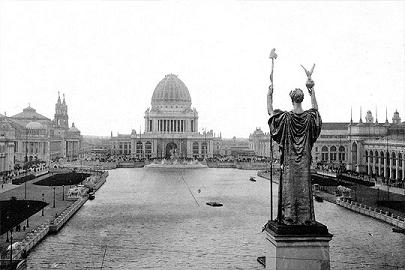
Daniel Burnham, working on reconstruction projects in the early 1870s, developed organizational skills that would produce the 1893 World's Columbian Exposition, coordinating 200+ buildings and dozens of architects as Director of Works, and ultimately the 1909 Plan of Chicago, America's first comprehensive city plan. The Plan's vision for a modern city, lakefront parks, diagonal boulevards, improved harbors, led directly to Wacker Drive (completed 1926), which replaced South Water Street: the exact block where CBOT was founded in a flour store attic in 1848.
The infrastructure those 82 merchants built in 1848 was replaced by infrastructure planned after the 1871 fire, completing a 78-year cycle from founding to fire to transformation.
ACT III:
THE SYNTHESIS
The Proof Moment: The Panic of 1873
The fire's test came immediately. The Panic of 1873, triggered by Jay Cooke & Company's collapse in September 1873, just 23 months after the fire, sent the American economy into a depression lasting six years. Construction across the country halted. Credit dried up. The Federal Reserve's own history identifies the Chicago and Boston fires as contributing causes, noting that national bank reserves in New York plummeted from $50 million to $17 million as insurance claims drained capital from the system.
Chicago absorbed the Panic differently. The city had rebuilt with real capital, financed by operating businesses, not speculation. CBOT volume held because agricultural futures became more valuable during uncertainty, not less. Farmers needed price protection when volatility exploded. The grain kept flowing through Chicago because the canal kept functioning, the railroads kept running, and the institutional standards Hudlun had saved kept the trades clearing.
The 1873 Panic proved what the fire had suggested: Chicago's competitive advantage was countercyclical. Joseph Ryerson's company not only survived but captured market share from iron and steel distributors in other cities that hadn't rebuilt or had borrowed to rebuild and couldn't service the debt when credit froze. The handbill issued while ashes were still warm was the competitive document that mattered.
CME, Ryerson, and Palmer: 155 Years of Proof
The pattern the fire revealed has compounded across every subsequent crisis. What made it work was never specific to 1871; it was structural.
CME Group, the modern successor to CBOT, processed 28.1 million contracts daily in 2025. When Lehman Brothers collapsed in September 2008 and global derivatives markets seized, Congress and the Federal Reserve looked to CME's clearing model as the template for Dodd-Frank reform. CME's then-CEO Craig Donohue testified before Congress that the exchange had $100 billion in collateral and had not experienced a single clearing failure. The same boring infrastructure bias that Hudlun's document rescue epitomized, preserve institutional memory at all costs, had compounded over 140 years into a system so resilient it became mandated law.
Ryerson Inc. operated from Chicago for 165 years, eventually merging into a publicly traded metals distribution company with $5.5 billion in annual revenue. The Palmer House operated continuously at State and Monroe for 130 years, the "World's First Fireproof Building" becoming the model for Chicago hotel construction for decades.
The Template
The fire established patterns that persist in Chicago's business culture with enough consistency to constitute competitive infrastructure rather than cultural mythology.
The first pattern: institutional memory is the non-burnable asset. Hudlun's document rescue was not heroism for its own sake. It was a precise recognition that CBOT's competitive advantage lived in its records. Chicago companies invest disproportionately in documentation, in process, in the unglamorous infrastructure that outsiders mistake for conservatism. Before Braintree built beautiful payment APIs, they spent years perfecting the unglamorous backend of payment processing, the institutional equivalent of Hudlun's document ledgers. That was the asset PayPal paid $800 million for.
The second pattern: crisis creates entry. The Christensen dynamic, played out physically. The trading pit closures of the 1990s and 2000s, which we will trace in later episodes, functioned by the same mechanism as the fire. Incumbents lost their structural advantage simultaneously. New firms formed from dispersed talent at the exact moment when the old relationship networks were being renegotiated. The mechanism is identical: structural advantage evaporates simultaneously, and the operators who move first into the vacuum compound beyond all proportion to their starting position.
The third pattern: geographic infrastructure creates an irreplaceable competitive position. Chicago companies that position themselves at critical network nodes, as CBOT positioned itself at the intersection of grain production and financial markets, as CME positioned itself at the center of global derivatives clearing, gain advantages that a crisis cannot eliminate because the advantages are structural, not physical. Thoma Bravo and GCM Grosvenor ($86 billion AUM) didn't build those positions in San Francisco or New York. They built them in Chicago, where the relationships between operators and capital have been compounding since the trading pit days.
The fire didn't create these patterns. It proved them. What the fire revealed in 1871 was what Chicago had actually built in the 23 years since 82 merchants climbed the stairs above Gage & Haines Flour Store: infrastructure that couldn't burn.
CLOSING
Joseph Turner Ryerson died on October 9, 1896, twenty-five years to the day after the fire reached his warehouse. He was 81. His company employed more than 500 workers and had dominated Midwest steel distribution for decades. His sons Edward and Arthur continued the business. His grandson Edward Jr. ran it through the 1940s and 1950s. The family business operated for 165 years in Chicago, compounding the decision made while the ashes were still warm.
Potter Palmer died in 1902. The Palmer House, rebuilt as the "World's First Fireproof Building," operated continuously at State and Monroe for 130 years before closing not to fire but to the COVID-19 pandemic in 2020, one of the rare Chicago institutions defeated by a biological crisis rather than a financial one.
Gurdon Saltonstall Hubbard died in 1886 at 84. The teenage fur trader the Potawatomi had named "Swift Walker," who had built Chicago's first warehouse when critics called it "Hubbard's Folly," told reporters in his final years that the fire was Chicago's defining moment. Not because of the destruction. Because of what the reconstruction revealed.
He was more precise than he knew. The fire didn't reveal Chicago's character. It revealed Chicago's architecture, the intangible infrastructure of standards, trust, relationships, and geographic irreplaceability that the 82 merchants had built since 1848. The fire just burned away everything else, leaving that infrastructure visible.
What couldn't burn compounded for 155 years.
Next: Chicago Episode 3, "Blood and Ice: How Chicago Fed America"; the Union Stock Yards, Gustavus Swift, and how Chicago invented industrial-scale meat processing, turning a regional slaughterhouse into the infrastructure that fed a nation.
You made it to the end!
You clearly find value in what we're building at Ventureology. Become a Founding Partner for full access to every future episode, biography, and visualization.
Become a Founding PartnerFounding member pricing is locked in for life. Only 100 spots.
Key Figures: Joseph Turner Ryerson (iron merchant, Connecticut; founding CBOT member; rebuilt from fire to 165-year dynasty) · Joseph Henry Hudlun (born enslaved, Virginia, c.1830; CBOT employee; saved institutional documents during fire; first African American homeowner in Chicago) · Reverend Robert Collyer (Unity Church pastor; "We have not lost our geography") · Potter Palmer (hotelier; rebuilt Palmer House as "World's First Fireproof Building") · William Butler Ogden (Chicago's first mayor; Union Pacific president; real estate losses) · Gurdon Saltonstall Hubbard (founding CBOT member; "Swift Walker"; warehouse destroyed; died 1886) · General Philip Sheridan (Civil War general; commanded federal troops during fire) · William LeBaron Jenney (Civil War engineer; designed Home Insurance Building, 1884) · Louis Sullivan (architect; "form follows function"; arrived 1873) · Daniel Burnham (architect; Director of Works, 1893 World's Fair; 1909 Plan of Chicago)
Key Dates: October 8, 1871, 9:30 PM (fire begins, O'Leary barn, DeKoven Street) · October 9, 1871, 3 AM (fire reaches CBOT; Hudlun saves documents) · October 9, 1871, dawn (General Sheridan arrives; telegrams Secretary of War) · October 10, 1871 (fire dies; Ryerson issues handbill) · February 12, 1872 (Chicago fire ordinance banning wood construction in Loop) · December 1871 (Central Union Block opens; 60 days after fire) · 1873 (Panic of 1873; Chicago companies survive on operating strength) · 1884 (Home Insurance Building; widely credited as world's first skyscraper) · 1888 (Rookery Building, Burnham & Root) · 1893 (World's Columbian Exposition; 21.5 million visitors) · 1909 (Plan of Chicago; Burnham) · 1926 (Wacker Drive replaces South Water Street)
Key Institutions: Chicago Board of Trade · CME Group · Palmer House Hotel · J.T. Ryerson & Son (became Ryerson Inc.) · Illinois & Michigan Canal · Chicago Fire Department · Chicago Architecture Center
Key Concepts: Incumbency Erasure: crisis simultaneously erases all established firms' accumulated relationship advantages, creating equal entry opportunity; the physical analog of Christensen's Innovator's Dilemma · Geography of Power: structural advantages conferred by irreplaceable geographic position that persist through physical crises · Institutional infrastructure: standards, trust networks, institutional memory, relationship capital; competitive assets that cannot be physically destroyed · Chicago Pragmatism Cycle (from "The 82 Merchants Who Invented Modern Finance"): Crisis → Pragmatic Solution → Infrastructure Build → Institutional Compounding, demonstrated again in post-fire reconstruction
Primary Sources: Elias Colbert & Everett Chamberlin, Chicago and the Great Conflagration (1872) · A.T. Andreas, History of Chicago, Vol. III (1886) · Chicago Relief and Aid Society, Report (1874) · Charles Henry Taylor, History of the Board of Trade of the City of Chicago (1917) · Goodsell & Goodsell, The Chicago Fire and the Fire Insurance Companies (1871) · Frederick Law Olmsted Papers, Library of Congress · General Sheridan's telegrams, greatchicagofire.org · Louis Sullivan, The Autobiography of an Idea (1924) · Daniel Burnham, Plan of Chicago (1909) · Bessie Louise Pierce, A History of Chicago: Volume III (University of Chicago Press, 1957) · Clayton Christensen, The Innovator's Dilemma (1997)
Ventureology™ · Chicago Series